
Most gyms that call themselves "powerlifting friendly" have a squat rack, a flat bench, and a deadlift platform somewhere in the corner. That's not a powerlifting gym — that's a commercial gym with the equipment a powerlifter happens to also use. If you're training the squat, bench, and deadlift seriously in Boulder, the difference matters. Here's how to tell them apart.
Start With the Plates
The fastest test of a powerlifting gym is the plates. Calibrated plates are manufactured to a tight weight tolerance — a 25 kg plate is 25 kg, not "about 25." Standard rubber-coated plates can be off by a meaningful margin, and that margin compounds across a loaded bar.
For a competitive lifter this isn't pedantry. If you're peaking for a meet, the number on the bar in training has to mean the same thing as the number on the bar on the platform. A gym that invests in calibrated plates is telling you who it's built for.
Platforms and Racks
Look at the racks and platforms next. Competition-spec racks and monolifts are built to hold a heavy squat without shifting or rattling. Custom-height platforms and competition benches put you in the right position for the lift you're actually training. Generic equipment works until the load gets real — then the small instabilities start costing you.
Quantity matters as much as quality. One platform in a busy gym means you train around everyone else's schedule. A real powerlifting gym has enough stations that a heavy session doesn't turn into a waiting game.
But the one piece of equipment experienced powerlifters look for first is the combo rack. A combo rack is a single station that handles both the squat and the competition bench press, with rapid, tool-free height and width adjustment — it is the rack standard on the platform at sanctioned meets.
GYM N°5 runs the Rogue Combo Rack — the model developed directly with the International Powerlifting Federation and IPF-certified for competition. It is the same rack used at IPF and USA Powerlifting meets: 3x3 steel uprights that set straight or angle inward five degrees, drop-in safety spotter arms, and a removable competition bench with a regulation Fat Pad. Train on it, and the rack under your squat and your bench on meet day is a rack you already know. Nothing about the setup is a surprise when it counts.


Most gyms in Boulder do not have one. A combo rack is expensive and purpose-built — a commercial gym has no reason to own one. Its presence on a floor is one of the clearest signals a gym is built for powerlifters, not around them.
The bar matters as much as the rack. A dedicated power bar — GYM N°5 uses Rogue Ohio Power Bars — is stiff, aggressively knurled, and built specifically for the squat, bench, and deadlift. It behaves nothing like the springy, mild-knurled multipurpose bar racked in a commercial gym, and under a heavy single that difference is the lift.
Conjugate and USAPL
Powerlifting is not one monoculture, and a gym serious about the sport accounts for that. One path is USA Powerlifting and the IPF — the classic meet, the combo rack built for it. The other is the conjugate camp: lifters trained in the Westside Barbell method, rotating max-effort and dynamic-effort work, leaning on specialty bars, accommodating resistance, and the equipped side of the sport. They are not the same training done two ways. They want different things from a gym floor.
GYM N°5 is built for both. The conjugate lifter gets monolifts — so a maximal squat comes off the hooks without a walkout, the way Westside trains it — and the Rogue Monster Westside Bench, the heavy-bench station inspired by Louie Simmons' designs: a double-reinforced steel spine, bolt-on diamond-tread spotter decks, pin safeties, band-peg compatibility for dynamic-effort work, and competition-width fat pads, so a shirted training bench sets up exactly as it will on the platform.
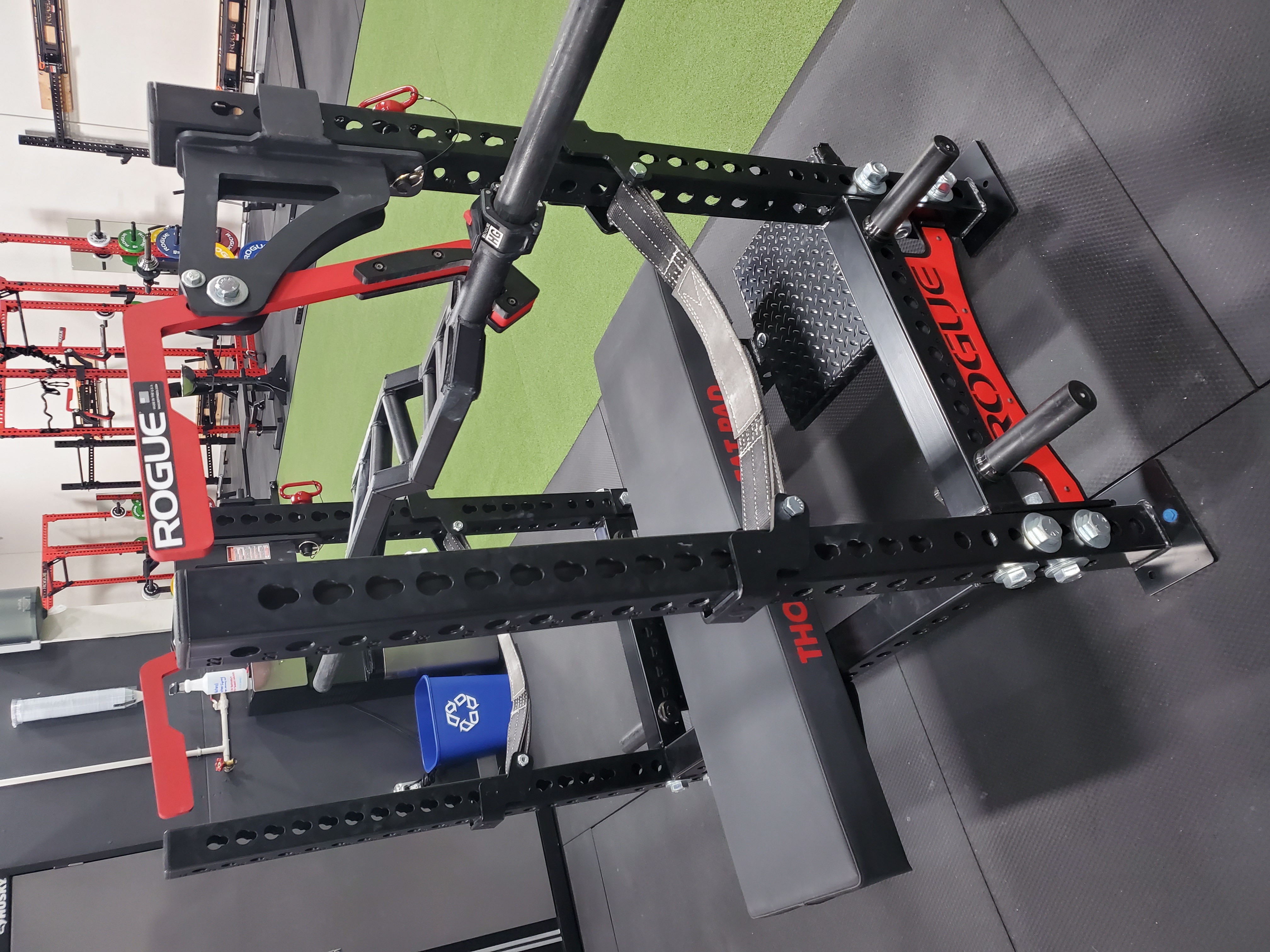
Run the USAPL route or run conjugate — both have a real setup here, not a compromise. Most gyms make you pick. This one doesn't.
Coaching and Meet Prep
Equipment gets you a place to train. Coaching gets you a bigger total. Ask whether the gym actually coaches powerlifting — programming, technique work, peaking — or just rents space.
If you intend to compete, ask specifically about meet prep: peaking blocks, attempt selection, making weight for your class, and competition-day handling. A gym that runs lifters through USAPL and USPA meets knows how to take you from a first platform to a qualifying total. A gym that doesn't will leave you to figure it out alone.
Access and Crowding
The best equipment in the city is worthless if you can't get to it. Two questions: what are the hours, and how crowded does it get? Powerlifting sessions are long. Waiting twenty minutes for a rack breaks the session and the focus.
Gyms that cap membership solve this on purpose. A capped, application-only gym trades volume for the guarantee that a rack is open when you arrive. For a serious lifter, that trade is worth making.
The Room
The last thing — and the hardest to measure — is the room itself. Walk in and look at what people are doing. A powerlifting gym has people warming up deadlifts, arguing about openers, and spotting each other's bench. That environment pulls your training up. A gym where you're the only one lifting heavy will, over time, pull it down.
GYM N°5 in Gunbarrel
GYM N°5, at 6420 Gunpark Dr STE B in Gunbarrel, Boulder, is built to clear every test on this list. The IPF-certified Rogue Combo Rack, monolifts and the Rogue Monster Westside Bench, calibrated competition plates, Rogue Ohio Power Bars, and custom-height platforms. It's a USA Powerlifting certified facility, with coaching that covers USAPL and USPA meet prep from a first total to a national qualifier. Membership is application-only and capped, with 24/7 access — so the rack is open when you are.
If you're choosing a powerlifting gym in Boulder, run any gym you're considering — including this one — through those five questions. The right gym answers all of them the same way you would.
Train at GYM N°5
Private strength training in Gunbarrel, Boulder. Powerlifting, Olympic weightlifting, strongman, physique, and athletic performance. 24/7 member access.