
There's a peculiar kind of intellectual paralysis that emerges in insular strength cultures, and you see it in Olympic weightlifting more than almost anywhere. A coach invokes "the Soviets" the way a priest invokes scripture, and the discussion is over — no analysis, no skepticism, no demand for evidence. Just ritual repetition. "The Russians figured this out in the 60s." It's delivered as a conversation-ending phrase, not an argument.
What's remarkable is how closely this mirrors every other ideological tribe in human history. The mechanics never change: isolate the group, sanctify the tradition, build canned responses to criticism, and discourage independent reasoning by framing outsiders as ignorant. Criticize a political tribe and you get "fake news," "you've been indoctrinated," "you don't understand." Criticize Olympic lifting orthodoxy and you get the strength-culture version of the same thing.
Psychologist Robert Jay Lifton mapped this process in Thought Reform and the Psychology of Totalism (1961), after studying ideological conditioning in Chinese prison camps following the Korean War. He identified recurring mechanisms inside rigid ideological systems: thought-terminating clichés, sacred doctrine, loaded language, pressure for conformity, and the subordination of reality to group mythology. What's striking is how cleanly that pattern transfers out of political extremism and into insular sports cultures. The language becomes ritualized, the doctrine becomes sacred, the group becomes emotionally self-sealing — and eventually criticism itself starts to feel like betrayal.
That's why so many Olympic lifting discussions sound eerily similar to ideological conditioning. "Our sport is different." "You don't understand Olympic lifting." "The Soviets already solved this." "They used steroids, we don't." The purpose of these phrases isn't clarification. It's containment. They are what Lifton called thought-terminating clichés — verbal escape hatches designed to shut down analysis before scrutiny can begin.
Nowhere is this clearer than in how coaches misuse Prilepin's Table.
The Soviet Scroll
Prilepin's Table has achieved almost mythical status in strength sports. Coaches quote it the way medieval theologians quoted Aristotle — often secondhand, usually poorly understood, almost never questioned in context. It was derived from observations of Soviet weightlifters; it was never meant to function as divine revelation. It was descriptive bookkeeping from a specific population under specific conditions. But over time the table hardened from a heuristic into doctrine — and like most inherited doctrine, the people repeating it rarely understand what it actually says.
Here is the chart:
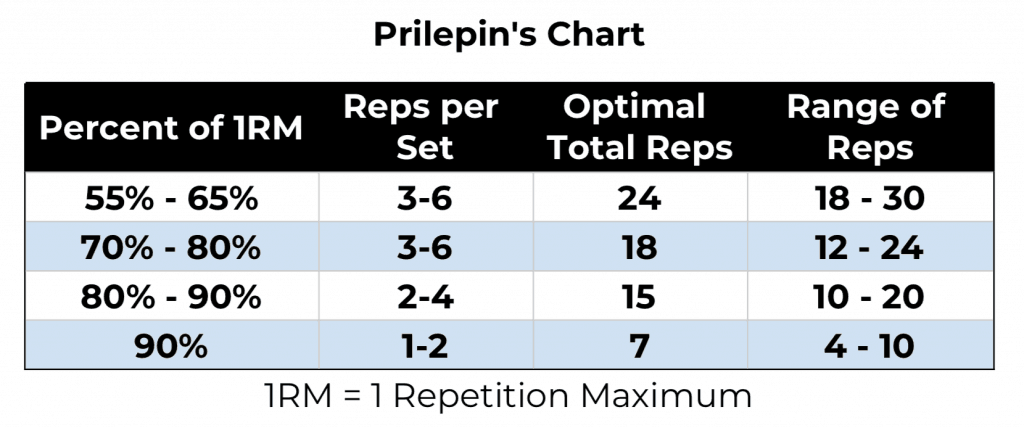
- 55–65% — optimal 24 reps, range 18–30
- 70–80% — optimal 18 reps, range 12–24
- 80–90% — optimal 15 reps, range 10–20
- 90%+ — optimal 7 reps, range 4–10
Notice the last line immediately. At 90% and above, Prilepin recommends 1–2 reps per set and a total range of only 4–10 reps. Not 15. That detail becomes important very quickly.
The Fake Average
The modern distortion usually looks like this. A lifter performs 5 sets of 3 at 90%+ — 15 heavy reps — then pairs it with 3 sets of 3 at 55%, another 9 light reps. The coach averages the whole session together:
(15 × 90) + (9 × 55) = 1,845
1,845 ÷ 24 = 76.9%
And concludes the session was "basically a 77% session" — as if the maximal-intensity work had been normalized by sprinkling in enough light volume to drag the spreadsheet average down.
The arithmetic is clean. The physiology is not. Prilepin's system is organized by intensity bands, not by session-wide averaging. The 90%+ work is its own distinct stress exposure; the 55% work is another. Reps belong to their own bucket, and they do not dissolve into each other because someone calculated a weighted average afterward. Fifteen reps at 90%+ are still fifteen reps at 90%+. Nine reps at 55% are still nine reps at 55%. Both count. Both accumulate fatigue.
Count them honestly and the picture inverts:
- 90%+ bucket — recommended 4–10 reps, optimal 7. Performed: 15. That is 150% of the upper limit, and more than double the optimal.
- 55–65% bucket — recommended 18–30 reps. Performed: 9. That is 30% of the upper limit.
Exposure is additive across zones, not averaged into one fictional middle intensity. The real number is 150% + 30% = 180%.
What the coach actually did was overdose one bucket and pretend the others were diluted. Nine reps at 55% do not erase them any more than eating a salad erases a bottle of whiskey. In fact, you just made a bad situation worse. The heavy work alone was already 150% — an overdose before a single light set was added. Then you added the light work to fix it, and it subtracted nothing. It stacked another 30% on top and carried you to 180%. That is what makes the fake average doubly stupid: first you convinced yourself you were fixing the problem, then you did the exact opposite of your goal.
A weighted average is not physiology. It is arithmetic cosplay. A nervous system does not care that your spreadsheet says 76.9%.
Why This Keeps Happening
The error is not merely mathematical — it is ideological. Many strength communities operate less like scientific disciplines and more like hereditary priesthoods. Knowledge is inherited socially rather than validated empirically. The hierarchy matters more than the evidence. Questioning methodology is treated as disrespect rather than inquiry. Coaches become curators of tradition instead of investigators of reality, and the conversation stops being about precision and starts being about preservation. The mythology has to stay intact: the Soviets possessed secret wisdom, Olympic lifting is uniquely exempt from broader principles, the old systems hold truths modern science merely "catches up" to.
That romanticism collapses under scrutiny. The Soviet system produced extraordinary athletes partly because it had massive talent pools, state-sponsored selection, industrialized doping, centralized coaching, and athlete attrition rates modern programs rarely acknowledge. What survived historically was not necessarily what was optimal — it was what persisted. Those are not the same thing. Evolution preserves survivorship, not perfection.
And there is an almost religious impulse in strength culture to assume old systems must hold hidden profundity simply because they are old. People hear "Bulgarian," "Soviet," "Eastern Bloc," and the critical faculties dim. But age is not validation. Ancient people also believed illness came from demons and that bloodletting cured disease. Tradition is not evidence; longevity is not proof; repetition is not truth. Real science thrives through revision. Strength culture too often treats revision as heresy.
What Honest Programming Looks Like
Honest programming starts with intellectual honesty. If heavy work was performed, count it. If fatigue was accumulated, acknowledge it. If a model has limitations, admit them.
Prilepin's Table is still useful — as a heuristic for organizing exposure, not as scripture. Used correctly, it is additive within intensity zones, never averaged across them. A lifter who does 5×3 at 90%+ and 3×3 at 55% has accumulated 150% of the allowable exposure in the top zone and 30% in the lower one — 180% total. The light work does not erase the heavy work. It adds its own. No averaging trick changes that.
Now compare a session written correctly — 3 sets of 2 at 90%, and 3 sets of 3 at 75%:
- 3×2 at 90% = 6 reps in the 90%+ bucket. Upper limit 10. → 60%.
- 3×3 at 75% = 9 reps in the 70–80% bucket. Upper limit 24. → 37.5%.
60% + 37.5% = 97.5%
Total exposure: 97.5% — under 100%. Both buckets respected, nothing overdosed. That is the difference between a prescription and a guess. One session lands at 97.5% of the budget; the other blows through it to 180%. No weighted average will ever tell you which is which.
The larger lesson runs past weightlifting. The moment a community treats inherited doctrine as immune to criticism, thought calcifies. Language becomes ritual. Questions become threats. People stop investigating whether the system is true and start defending it because it is theirs. At that point you are no longer coaching. You are preserving mythology.
What it costs — next. This essay set out to prove the math is wrong. It is. The harder question is what getting it wrong actually costs — not in spreadsheet points, but in broken athletes, in lifters who plateau for months and never learn why, in coaches worn down chasing problems they wrote themselves, one fake average at a time.
That is the next article. To be continued.
References
Background on Robert Jay Lifton's Thought Reform and the Psychology of Totalism and the thought-reform model referenced above:
- Thought Reform and the Psychology of Totalism — Wikipedia
- Robert Jay Lifton, Thought Reform and the Psychology of Totalism (1961) — Google Books
- The True Story of Brainwashing and How It Shaped America — Smithsonian Magazine
- Brainwashing — Wikipedia
Train at GYM N°5
Private strength training in Gunbarrel, Boulder. Powerlifting, Olympic weightlifting, strongman, physique, and athletic performance. 24/7 member access.